
- 作者:帝平成
- 来源:公主小妹
- 发布时间:2026-08-26
临时天堂
AI-generated films enter China’s mainstream awards through new AIGC unit_我的网站

一 |

For the first time in the 64-year history of the awards, this year's edition introduced an AI-generated content (AIGC) recommendation unit, giving AI-generated films a new pathway into a major film award platform.
The move reflects a broader shift in the relationship between technology and cinema.
Rather than replacing filmmakers, AI is increasingly seen as a creative tool that lowers production barriers, expands visual possibilities and allows more people to turn ideas into films, Zhang Peng, an associate professor at Nanjing Normal University, told the Global Times.
The AIGC recommendation unit, launched on June 30, attracted 2,038 entries from around the world in just over a month. After evaluation, six productions received the "Hundred Flowers AIGC Recommendation Honor," covering categories including animation, visual effects, technology, creativity, directing and short films.
For many young filmmakers, AI has opened a new path into the industry. Multiple award-winning creators said at a seminar on the sidelines of the Hundred Flowers Awards that AI tools such as Jimeng and the Seedance model helped them with visual development, shot design, dubbing and maintaining emotional continuity.
Zhang Bohang, a representative of the team behind Yi Meng (A Dream), which won the award for Best Animated Work, said at the seminar that animation had long been a dream for the team, but high production costs had previously made it difficult to bring that dream to life. "The emergence of AI has given us a way to make our dreams come true," he said.
Lu Qiwei, a representative of the creative team behind Yecha Crossing the River, which won the Best Creative Work award, said at the seminar that Seedance allows creators to input characters, scenes, visual styles and directorial ideas, then select and organize the generated material themselves.
However, filmmakers at the event also emphasized that AI does not replace human creativity. Director Liu Shuheng, whose work Out of Control received recognition, said AI had lowered the threshold for creating visual images while raising the expectations for creators' decisions.
"AI makes it easier to create a picture, but it also makes people think more about why they choose to shoot it this way," Liu said at the seminar.
The shift is not limited to AI-powered filmmaking. The awards are also expanding recognition for emerging forms of storytelling.
The 38th Hundred Flowers Awards also introduced a new short-drama recognition section, marking the first time the awards had recognized short dramas. It marked the first time the awards had included short dramas in their recognition system, organizers said.
AI also featured prominently in the event's audience experience. Global Times reporters observed interactive installations that allowed audiences and celebrities to generate personalized digital keepsake photos, while AI was also used during the red-carpet livestream to provide real-time commentary, answer viewer questions and enhance visual backgrounds.
The Hundred Flowers Awards' embrace of AIGC comes as major Chinese film festivals increasingly explore AI's role in cinema.
Since its launch in 2024, the Beijing International Film Festival's AIGC Film Section has been the first dedicated section at a major film festival worldwide to focus on AI-powered image-making. Meanwhile, the Shanghai International Film Festival this year has launched a new "AI Studio" section, aiming to create the first experimental platform dedicated to exploring AI-assisted collaboration in film production.
From competition entries to audience experiences, these developments suggest that AI is no longer just a behind-the-scenes production tool, said Zhang.
"AI is gradually moving beyond being a filmmaking tool and becoming part of the broader film festival ecosystem," Zhang noted.
"From AI-generated films to short dramas, the move also shows how China's mainstream film platforms are embracing emerging formats and recognizing new forms of storytelling."
。
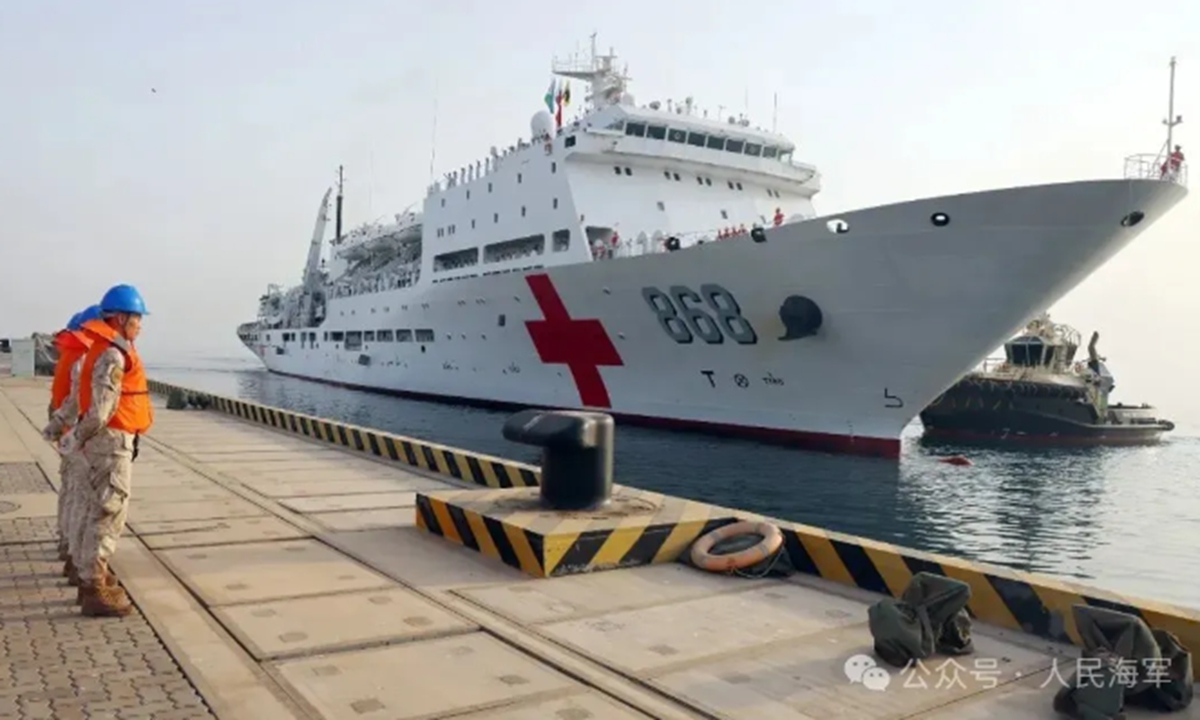
The Chinese People's Liberation Army (PLA) Navy hospital ship, Auspicious Ark, deployed for Mission Harmony-2026, made a technical stop at the PLA's support base in Djibouti on Tuesday local time, where it is scheduled to provide medical services. A Chinese expert said that in addition to addressing the healthcare challenges facing Chinese military personnel stationed overseas, the ship can extend humanitarian medical assistance locally, thereby demonstrating China's commitment to fulfilling its responsibilities through concrete actions.
The ship moored at the dock of the PLA support base in Djibouti at around 7 am, with mission personnel waving to those who came to greet them onshore. Staff from the Chinese Embassy in Djibouti, service members stationed at the support base, and representatives from the 48th Chinese Naval Escort Taskforce attended the welcome ceremony, according to a release from China's Ministry of National Defense on Wednesday.
During the technical stop, the ship will replenish supplies including food and fuel and provide medical treatment for troops stationed at the support base as well as service members of the escort taskforce, according to the release.
According to a video clip released by China Central Television (CCTV) at noon on Wednesday, the Type 052D destroyer Tangshan from the 48th Chinese Naval Escort Taskforce is also currently docked at Djibouti.
Commissioned in 2025, the newest Auspicious Ark is equipped with virtually all the sophisticated medical equipment found in a top-tier hospital, enabling it to provide effective, professional medical care across a variety of operational settings. It has since taken part in several maritime medical support exercises, the Xinhua News Agency reported.
Equipped with 18 clinical departments and five auxiliary diagnostic units, the ship is capable of performing more than 60 types of medical examinations, treatments and procedures spanning general surgery, orthopedics, obstetrics and gynecology, ophthalmology and more. Its eight onboard standard operating rooms support simultaneous surgeries, while an onboard helicopter enhances its emergency medical rescue capabilities, per Xinhua.
The Chinese hospital ship maintains a standard of diagnosis and treatment equivalent to that of a tertiary hospital, the top of China's grade hospital system, enabling it to accurately diagnose and treat the ailments of military personnel deployed overseas, Song Zhongping, a Chinese military affairs expert, told the Global Times on Wednesday.
Given Djibouti's harsh climatic environment, the ship's stopover there also reflects the care extended to military personnel stationed overseas, Song added. He said he expects the PLA to send hospital ships to the PLA Support Base in Djibouti on a regular basis.
Mission Harmony-2026, the 12th iteration of Mission Harmony since 2010, is scheduled to last over 200 days, during which the ship will visit multiple African and South Asian countries to provide free medical services to local populations, Xinhua reported.
Since setting sail on July 22, the task force has conducted a series of drills covering counter-terrorism and anti-piracy operations, helicopter-borne maritime medical evacuation, reconnaissance and evidence collection. These exercises are designed to bolster emergency response capabilities and ensure personnel and equipment remain in optimal condition, according to China's Ministry of National Defense.
The current security situation in the Middle East remains precarious, with the potential to spill over into Africa. In this context, the present mission is well positioned to provide timely rescue and relief operations in the event of regional contingencies, Song said. With the Ebola virus still rampant across parts of Africa, the Chinese hospital ship could also provide humanitarian medical support whenever public health crises emerge in neighboring countries, he added.
These tangible efforts exemplify China's commitment to upholding global responsibility and conveying goodwill through practical, peace-oriented actions, according to Song.
Mission Harmony is an overseas humanitarian medical service program organized by the PLA Navy. This initiative aims to enhance traditional friendship and pragmatic cooperation between China and relevant countries, provide the international community with more public security products, better implement the Global Security Initiative, and contribute to building a maritime community with a shared future, according to a prior statement from China's Ministry of National Defense.
。
Current article:http://www.zuanniangwandangliaolinechu.sbs/dra/gsh.doc
Published on:10:34:50
- 本文标签:
- 越狱第四季