人的价值
外交部:愿继续同联合国和世界各国一道,不断推动人工智能开放、包容、普惠、向善发展_我的网站

一 | 中新网北京8月24日电(记者 李京泽 李晓喻)中国外交部发言人林剑24日主持例行记者会。
有记者提问:我们注意到,继联合国秘书长古特雷斯来华出席2026年世界人工智能大会暨人工智能全球治理高级别会议后,联合国常务副秘书长日前在西安出席“人工智能与人类发展”对话会。
China is set to launch its first joint archaeological project in South America, following an agreement between Chinese and Peruvian institutions to study the ancient Caral civilization. The move marks a new milestone in the country's growing overseas archaeological cooperation.
The Institute of Archaeology of the Chinese Academy of Social Sciences, Peru's Caral Archaeological Zone under the Ministry of Culture, and the Professional School of Archaeology at the National University of San Marcos signed a cooperation agreement on Saturday to conduct research on the ancient Caral civilization.
The Caral civilization, which is considered to be the oldest civilization discovered in the Americas, emerged along Peru's northern coast and dates to around 3000 BC to about 1800 BC.
The project marks China's first joint archaeological initiative in South America, expanding its overseas archaeological footprint to four continents: Asia, Africa, Europe and South America. It also encompasses cooperation with Belt and Road partner countries, major centers of ancient civilizations and regions crucial to the study of human origins.
For Chinese archaeologists, the project represents a new step in overseas archaeological engagement and international cooperation, fostering mutual learning and dialogue among civilizations, Chinese experts said.
Cooperation beyond borders
In recent years, Chinese institutions have participated in a series of overseas archaeological projects, from exploring ancient cities along the Silk Road to studying early civilizations in Africa and Central Asia.
They not only brought Chinese expertise and talent, but also advanced Chinese technologies, equipment and solutions, experts said.
In February, a significant archaeological breakthrough has emerged from Mit Rahina in Giza, the site of ancient Memphis in Egypt, where a joint Chinese-Egyptian mission has uncovered a limestone structure believed to be connected to the temple of King Pharaoh Apries from Egypt's 26th Dynasty (664-525 BC), according to the Xinhua News Agency.
Zhang Hai, head of the Chinese team and an archaeologist from Peking University, told the Global Times in a previous interview that the Chinese contingent applied distinctive methods for documenting and recording finds, while deploying Chinese-developed technologies such as the "4D kankan Meta" 3D scanner for precise, real-time topographic and sectional modeling, plus specialized software for capturing dislocated stone elements in 3D to aid future digital restoration and preservation.
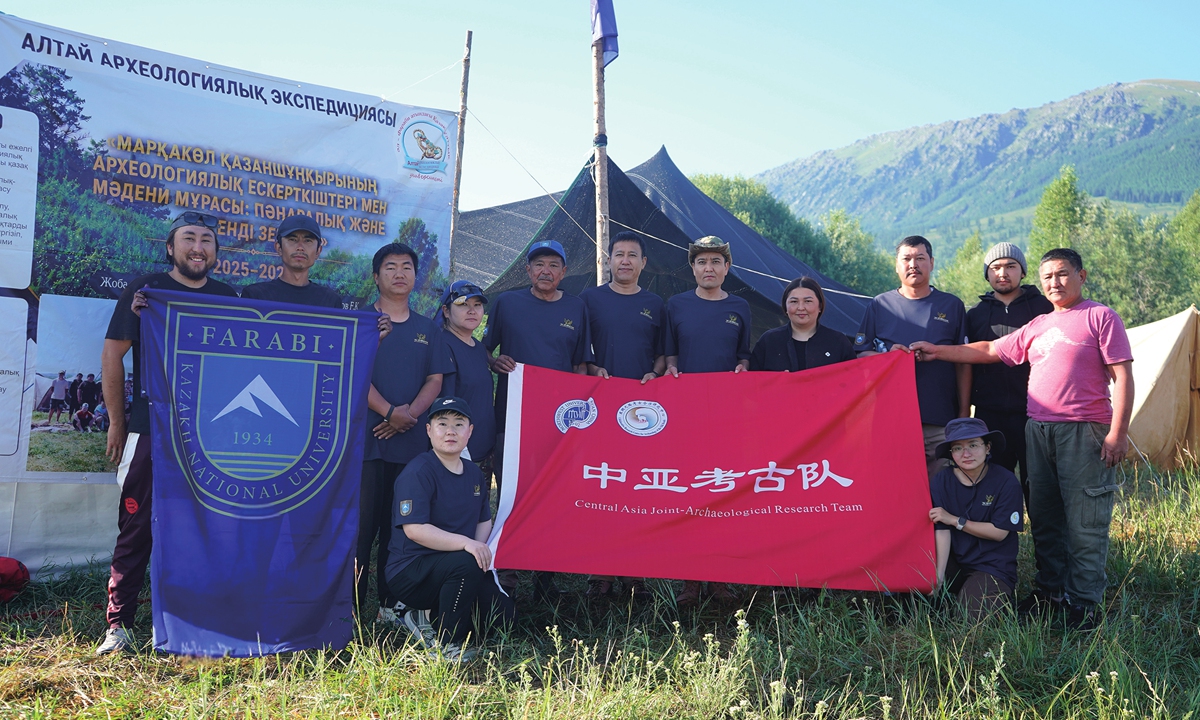
In the latest China-Kazakhstan joint archaeological project, Chinese equipment and technologies played an important role in the team's discoveries.
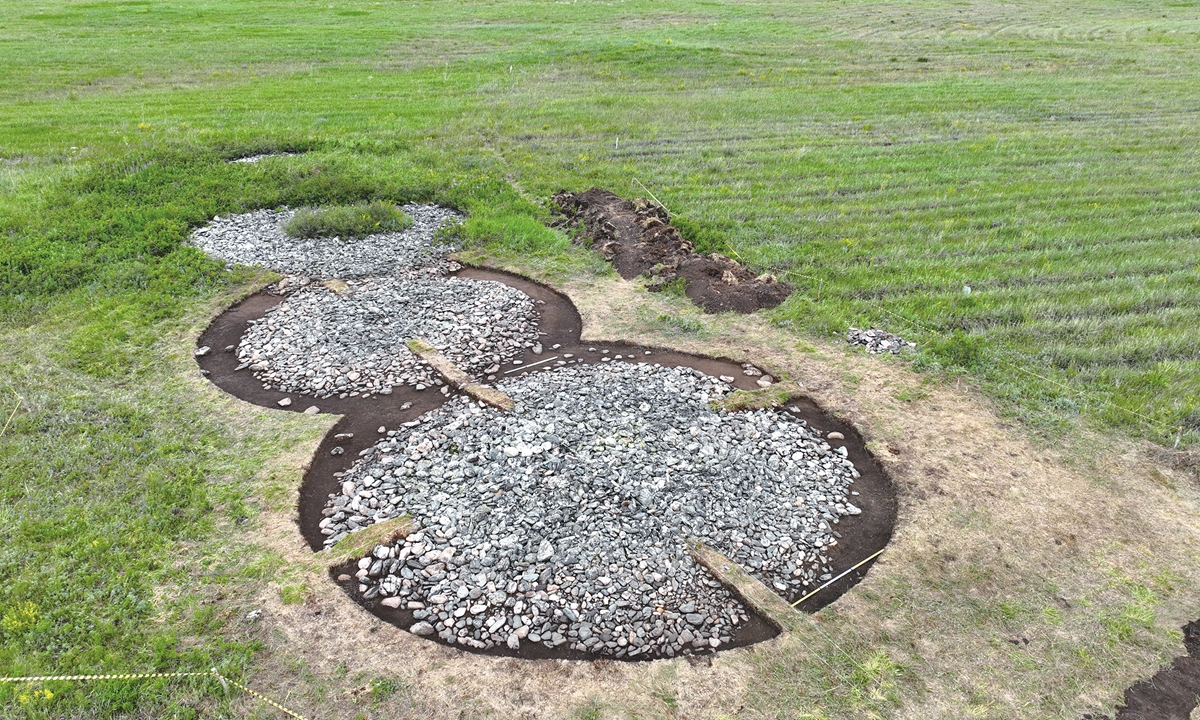
Building on the excavation, the archaeological team used drones and the "I Survey" mobile field documentation system to conduct systematic surveys around the excavation area. The survey covered more than 10 burial grounds and documented more than 50 Pazyryk-era tombs.
Pazyryk culture flourished from the late sixth century BC to the third century BC, Shao Huiqiu, a professor at the Collaborative Research Center for Archaeology of the Silk Roads, Northwest University, told the Global Times.
According to Shao, who is the Chinese lead for the China-Kazakhstan joint archaeological project, none of the tombs had previously undergone formal excavation, giving them significant research potential. The use of these technologies has enabled the team to carry out more efficient and comprehensive surveys of the area,
During the China-Kazakhstan joint archaeological project, archaeologists have recovered a number of important artifacts, including human remains, pottery, gold foil pieces, horse bones and iron horse equipment.
The finds have provide valuable material evidence for studying the burial practices, funerary customs and material culture of the Pazyryk culture in the Lake Markakol region, said Shao.
Researchers also conducted regional surveys around the excavation area, documenting more than 50 Pazyryk-era tombs.
Through the joint archaeological project, China and Kazakhstan have gained a deeper understanding of Bronze Age to Early Iron Age archaeological remains in the Lake Markakol basin, according to Shao.
In 2027, the two sides will continue excavations at key sites and burial grounds identified during the survey, while advancing regional archaeological investigations, data analysis, multidisciplinary research, young archaeologist training and academic exchanges.
Archaeological exchanges
China's overseas archaeological cooperation has also become a platform for broader exchanges among researchers and civilizations.
Such projects, experts say, are helping expand archaeological research beyond national borders and provide new perspectives on exchanges among ancient civilizations.
China's overseas archaeology has grown alongside its broader participation in global cultural heritage protection.
The National Cultural Heritage Administration's cultural heritage development plan through 2030 calls for expanded archaeological cooperation in Austronesian-speaking regions, trans-Himalayan areas, and routes connected to the Silk Road and Maritime Silk Road, reported Xinhua.
The plan seeks to strengthen the methods used to trace Chinese cultural artifacts overseas, and advance efforts to retrieve lost cultural relics.
It also pushes for greater Chinese participation in global cultural heritage governance and expanded international partnerships, including new protection cooperation agreements with more countries worldwide, according to Xinhua.
In these joint collaborations, researchers from different countries bring together their expertise in regional archaeology and fieldwork, conducting exchanges on archaeological surveys, excavations, multidisciplinary research and regional cultural studies. Such cooperation has strengthened mutual learning and laid a foundation for long-term partnerships, according to Shao.
The China-Uzbekistan cooperation has established research centers in Samarkand and Termez to support studies on human-environment interactions and cultural heritage. The initiative has also trained professionals in Silk Road archaeology, scientific research and heritage conservation through programs for Uzbek universities and research institutions, while promoting international academic exchanges to advance Silk Road heritage protection and cultural cooperation, noted Zhu Jiangsong, a member of the China-Uzbekistan joint archaeological team from the School of Cultural Heritage, Northwest University.
Through these partnerships, Chinese archaeologists are not only contributing technology, research experience and training, but also gaining first-hand materials and fresh perspectives that help advance the study of ancient civilizations and enrich China's archaeological research.
。发言人能否进一步介绍有关情况? 林剑:8月20日至21日,“人工智能与人类发展”对话会在西安举行。此次对话会由中国外交部和联合国共同主办,联合国常务副秘书长阿明娜出席并致辞,对话成果将向第81届联合国大会提交。 不久前,习近平主席从人类文明进步的角度围绕人工智能带来的机遇和挑战,提出坚持开放共赢、强化风险意识、鼓励包容并蓄、倡导和衷共济4点意见,引起国际社会强烈共鸣。这次对话会的宗旨同习近平主席的重要论述高度契合,各国代表从历史纵深、哲学高度和现实视角探讨人工智能对人类发展的深刻影响。

二 | 联合国秘书长和常务副秘书长相继来华出席人工智能国际会议,充分反映人工智能这一前沿技术对于当今世界的重要意义,也体现中方始终支持联合国在人工智能全球治理中发挥主渠道作用。西安是古丝绸之路的东方起点,承载着东西交融、文明互鉴、和合共生的辉煌历史,有助于各方从历史长河中汲取智慧,共同回答人工智能带来的时代之问,增进各国共同福祉。 各国与会嘉宾普遍认为,在人工智能发展中应当坚持以人为本、向上向善、机遇共享、责任共担,更多关注发展中国家和弱势群体的利益,利用人工智能赋能人类发展和文明进步。 中方愿继续同联合国和世界各国一道,不断推动人工智能开放、包容、普惠、向善发展,更好服务国际社会普遍福祉。(完) 【编辑:陈海峰】。
Current article:http://www.zuanniangwandangliaolinechu.sbs/news/20260826_1167.doc
Published on:01:41:37
 朝5晚9
朝5晚9 极度深寒
极度深寒 情牵两世
情牵两世 一拳超人
一拳超人 大都会
大都会 千方百计爱上你
 有希望的男人
 性爱大师
性爱大师


